
Blog
The cover image for this post is being embroidered. Once it is ready, it will frame this post.
Khnum in Esna
If you thought I would not return to talking about Egypt in this space, you were mistaken.
As I said a few texts ago, astrologically I have Pallas retrograde—that is, anchoring myself in the justification under astrological influence, I have been working on this text in a much deeper way than I initially conceived.
In the heart of Egypt, about 60 kilometers south of Luxor, lies one of the most fascinating testimonies of the religious architecture of the Greco-Roman period: the Temple of Esna.
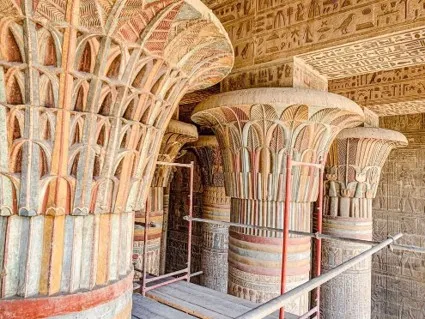
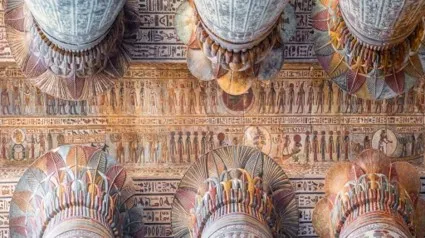
Of the great original complex, the best-preserved element is its pronaos, the great monumental vestibule that preceded the main sanctuary, supported by twenty-four columns, which remained buried and partially hidden for centuries.
In Egypt, the term vestibule refers to an entrance chamber or transitional space in the architecture of temples and tombs. It connected the exterior (open courtyards) to the inner sanctuaries, serving as an antechamber before access to the sacred rooms.
The temple was dedicated to Khnum, the god represented with a ram’s head. Associated with fertility, creation, and the sources of the Nile, Khnum is considered the divine potter who molded men and gods on his wheel.
The construction of the temple began in the Ptolemaic period, around the 2nd century BC, and was expanded during Roman rule, with additions made up to the reign of the emperor Claudius (41–54 AD). The site also holds records of other deities worshiped in the region, such as the goddess Neith, to whom bow and arrow were offered.
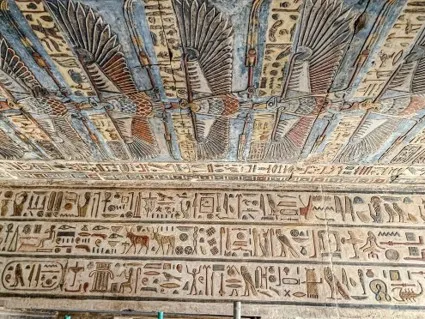
For nearly 1,800 years, local residents lit fires in the temple’s vestibule, covering the walls and columns with a thick layer of soot. It was only in 2018 that a joint restoration project between the Egyptian Ministry of Tourism and Antiquities and the University of Tübingen, in Germany, began to reverse this process.
Under the leadership of Egyptologist Christian Leitz and restorer Ahmed Emam, a team of approximately 30 Egyptian restorers worked meticulously to remove the accumulated dirt. The process was so meticulous that, at times, toothpicks were used to scrape the soot without damaging the underlying inscriptions.
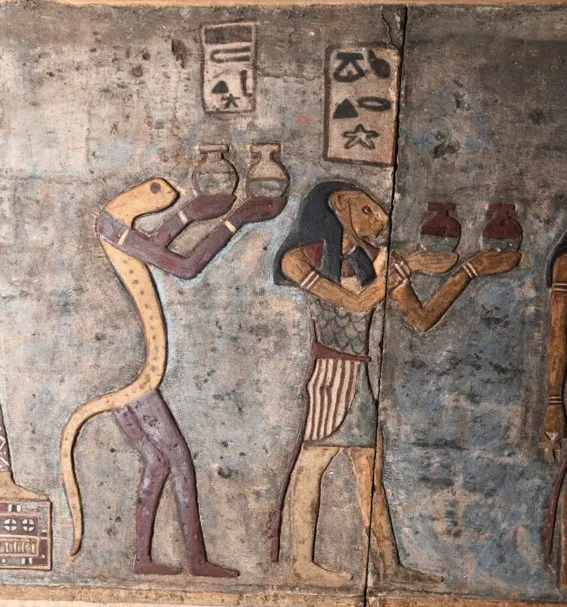
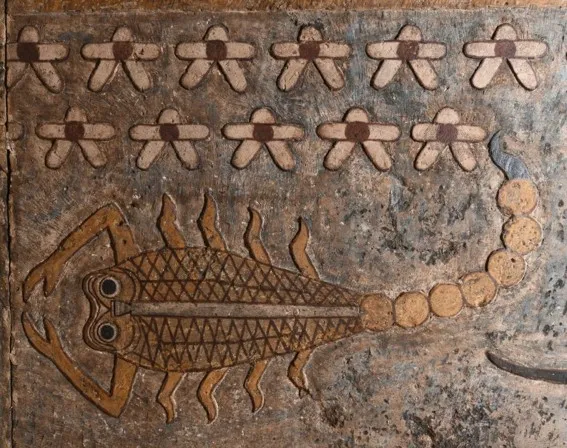
The results completely transformed our understanding of the temple’s original decoration. The original colors of the reliefs were restored, revealing details previously completely invisible, including the garments of the kings, the crowns, and the thrones of the deities.
What makes the discovery even more special is the predominant color palette. Unlike other temples, this one in Esna, after cleaning, drew attention for the strong presence of ochre, red, and yellow tones, which came to appear with unusual intensity when compared to other already-restored Egyptian temples, such as Dendera.
These colors, extracted from minerals and natural pigments, carry a deep harmony with the surrounding landscape and with the textile materials used in Ancient Egypt:
- The ochre yellow, obtained mainly from natural ochres, was associated with gold, the sun, and the imperishable nature of the gods, with the desert sand and the scorching sun that bathes the Nile Valley. It is the color of dry earth, of the light that reveals everything.
- The earthy red evokes blood, life, and was simultaneously associated with vital energy, power, the desert, and, in some contexts, the forces of chaos brought by the river’s floods, and pigments extracted from iron oxide present in the region’s own geology.
- Egyptian blue, present in details, was considered the first synthetic pigment produced on a large scale by humanity, created from silica, lime, and copper, but which echoes the color of lapis lazuli and the night sky. When applied, it brought into the temple’s interior the very essence of the celestial vault.
- Green, obtained from malachite, refers to the lush vegetation that sprouts on the banks of the Nile, a symbol of renewal and perennial life, the regeneration of Osiris.
- White, extracted from gypsum or calcite, as ritual purity.
- Black, from charcoal, served to create contrast and give depth to the figures. Also the fertile earth left by the Nile’s floods.
For the Egyptians, color possessed symbolic efficacy. Painting a deity or an object was not merely representing it visually, but activating attributes associated with that color. Green evoked regeneration, blue referred to the sky and the primordial waters, yellow brought the figures closer to the imperishable gold of the gods. In this sense, painting was part of the temple’s own religious language.
This palette, extracted directly from nature, converses with the textile materials that were the heart of Egyptian daily life. The same chromatic palette also appeared in the linen fabrics used by the elite, by the priests, and in various everyday objects, although not always produced by exactly the same pigments employed in temple decoration to dye the linen threads, Egypt’s most noble fiber, and the garments of the deities and priests.
The paintings of the Temple of Esna remind us that color is also a historical document. For centuries, it was believed that Egyptian temples were almost monochromatic stone constructions. The restoration revealed precisely the opposite: they were intensely colorful. Recovering these pigments does not only mean returning beauty to the walls, but recovering an ancient way of understanding the world, in which art, nature, religion, and technique were inseparable dimensions.
Today, this color palette, added to the layers of time by the years that have passed, made me look at the columns of the vestibule and immediately see a pile of natural linen fabrics ready to be embroidered. For me, it was the same vision as a fabric store. At the moment this image consolidated, I realized that this was the identity that Devir Bordado would occupy in the world. Not because it speaks of fabrics, but because it speaks of permanence through time.
View references
- AMERICAN RESEARCH CENTER IN EGYPT (ARCE). Conservation of the Temple of Esna. Alexandria: ARCE, 2026. (Suggested reading here)
- CELESTIAL reliefs depicting the heavens uncovered in the Temple of Esna. Beijing: UNESCO-HIST, Mar. 23, 2023. (Suggested reading here)
- EBSCO INFORMATION SERVICES. An Egyptian Temple Reborn. Ipswich: EBSCO, 2026. (Suggested reading here)
- LEONARD, Benjamin. An Egyptian temple reborn. Archaeology, Long Island City, v. 78, n. 2, p. 22, Mar. 2025. (Suggested reading here)
- NATIONAL GEOGRAPHIC. Vivid colors of ancient art uncovered in Egypt’s Temple of Esna. [S. l.]: National Geographic, June 20, 2024. (Suggested reading here)
- PHYS.ORG. New reliefs uncovered in Egyptian Temple of Esna. [S. l.]: Phys.org, Oct. 2024. (Suggested reading here)
- REVISTA GALILEU. Restauração em templo no Egito revela pinturas feitas há 2 mil anos. São Paulo: Globo, May 2022. (Suggested reading here)
- REVISTA PLANETA. Pinturas excepcionais de deusas são descobertas em templo egípcio. São Paulo: Três, 2022. (Suggested reading here)
- UNIVERSITÄT TÜBINGEN. The Temple of Esna Project. Tübingen: IANES, 2026. (Suggested reading here)

Founder of Devir Bordado, but also an embroiderer and researcher. This text is part of an ongoing investigation into how making produces knowledge, memory, and transformation.
Tags
African Diaspora African Diáspora Alice in Wonderland Amazon Ancestry Apple Archaeology Archetypes Astrology Astronomy Autumn Becoming Beltane Botanical Cake Colonization Cycles Embroidery Equinox Esotericism Feminism Greece Hermeticism History Hórus Indigenous Cosmology Information Science Journals Library Science Mabon Magic Memory Moon Music Orishas Ouroboros Recipes Research Science Communication Serpent Symbolism Tarot Technology Textile Art Thoth Time Transformation Wheel of the Year Winter Yule